
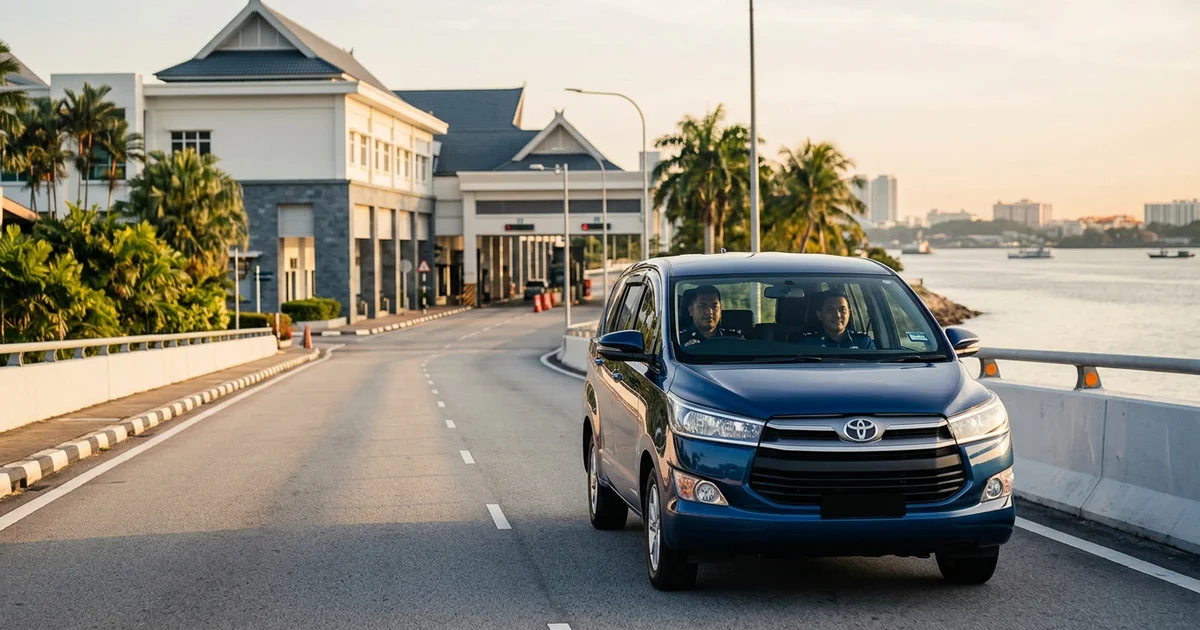
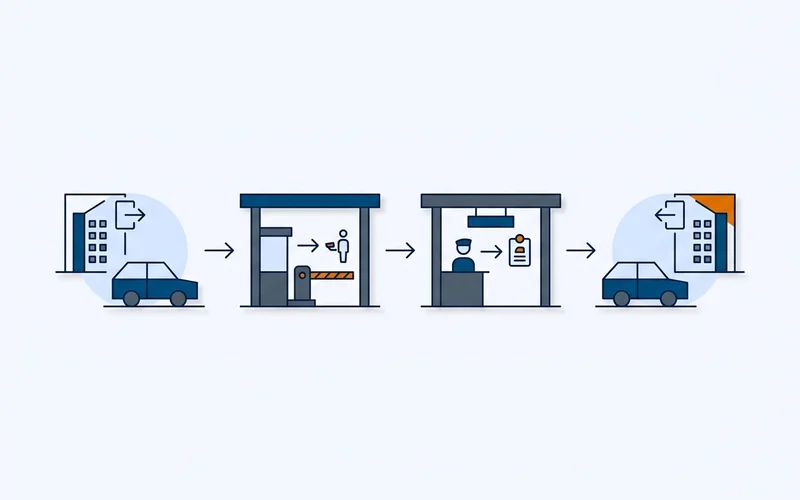
In short: a private car from Kuala Lumpur to Singapore is about four to five hours of driving plus checkpoint time, in four stages: the PLUS Expressway south, the Malaysian checkpoint (the Sultan Iskandar Building in Johor Bahru via the Causeway), the Singapore checkpoint at Woodlands, then the drop-off. At both checkpoints you step out and walk to the immigration counter, and at one you also carry your luggage through the customs scanner; your driver meets you after each. A quiet weekday crossing takes about 20 minutes.
Every week, business leaders and families ask us for the easiest way to cross Malaysia Singapore border.
Flying into KLIA first? The KLIA to Johor Bahru private transfer is bookable online from MYR 812 per car; message us to extend it across the causeway. Flying into Senai instead? The Senai Airport to Johor Bahru transfer is from MYR 234 per car.
The reality is that the KL to Singapore by car route crosses one of the busiest land borders in the world, making careful preparation vital.
We provide a dedicated cross-border travel service to make this long day feel effortless. This daily route operates in both directions, and the core clearance sequence stays exactly the same.
Our team knows exactly how to manage the heavy traffic volumes. Let’s break down the specific checkpoint process and exactly how to prepare for a smooth transit.
The Journey in Four Stages
The Kuala Lumpur to Singapore trip requires a long day on the road, but it is a simple one once you know its shape. We break the entire transit down into four highly predictable segments.
Stage 1: The Drive South
Your journey begins right at your pickup address in the Klang Valley. The car heads south down the PLUS Expressway, passing Seremban and Malacca before entering Johor. Expect roughly four hours of driving with one rest stop built into the schedule.
Stage 2: The Malaysian Checkpoint
Immigration and customs clearance happens first on the Malaysian side at either the Bangunan Sultan Iskandar (BSI) or Sultan Abu Bakar Complex (KSAB). Private car passengers step out and walk to the immigration counter with their passports, then rejoin the car after clearance.
Stage 3: The Singaporean Checkpoint
The same walk to the counter repeats a few minutes later on the other side of the crossing, at either the Woodlands Checkpoint or the Tuas Checkpoint. At one of the two checkpoints you also take your luggage through the customs scanner.
Stage 4: On to Your Address
Your driver meets you after clearance and takes you straight to your final Singapore destination in the same car. There are no vehicle transfers.
What Happens at Each Checkpoint
This specific part of the journey generates the most questions from clients, so here is the exact detail. We always aim to demystify the malaysia singapore checkpoint process for first-time riders.
You do not stay in the car. Your driver drops everyone at the passenger area, and each traveller walks to the immigration counter and presents their own passport. The officer processes it, may ask a routine question, and you walk on to meet the car.
At one of the two checkpoints you also take your luggage with you and put it through the customs scanner; at the other, your bags stay in the car. There is no fast lane for private car passengers, so the queue at the counter is the same one everyone else uses.
Between the two checkpoints, your car crosses the physical link over the water. This will be either the Johor-Singapore Causeway in the east or the Tuas Second Link in the west. You then repeat the clearance sequence for the other country.
Digital Clearance Options
Both countries are rolling out QR and automated clearance through apps such as MyICA and MyNIISe. Eligibility depends on your nationality and changes from time to time, and it does not replace the walk to the counter area. We tell you what applies to your group before you travel. Either way, keep your physical passport on you.
Why the Public Bus Is Harder
To be fair to the coach operators, their actual vehicles are perfectly comfortable and the ticket fares are much lower. Everyone, bus or car, clears immigration on foot at the counter. The difference is what happens around it.
On a standard coach, everybody must disembark at the Malaysian checkpoint with all their belongings. The process involves several tiring steps:
- Unloading all heavy luggage from the undercarriage.
- Walking through the massive immigration hall on foot.
- Clearing the manual passport control counter.
- Finding and re-boarding the specific coach on the far side, which will not wait long for stragglers.
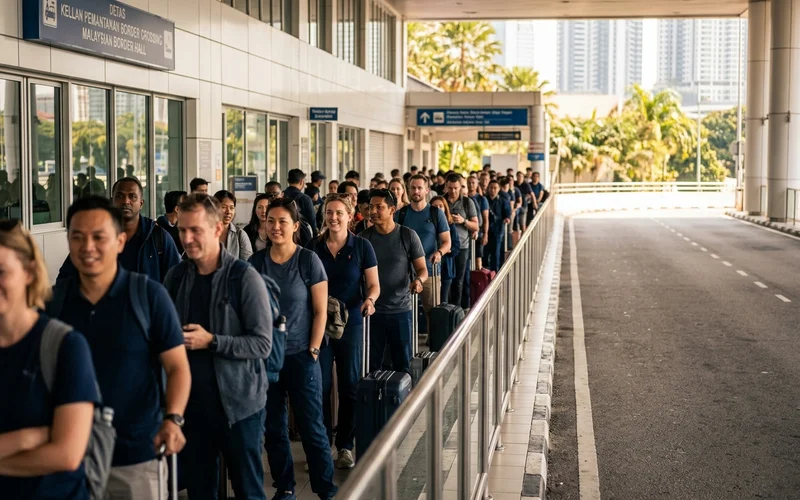
Then the cycle repeats at the Singaporean checkpoint, with luggage, and ends at a terminal where you still need a taxi or MRT. For a solo backpacker, this is only mildly annoying.
For a family with young children, elderly relatives, or four large suitcases, it is harder. A private car does not remove the walk to the counter, but it halves the luggage carrying, keeps one car waiting for you, and ends at your door. Our checkpoint walkthrough covers exactly what you do at each stop.
Realistic Timing
Travel times fluctuate wildly, but mapping out the journey helps set proper expectations. We track crossing data daily to help passengers choose the best possible departure window.
| Segment | Typical duration |
|---|---|
| Klang Valley to Johor Bahru | About 4 hours plus one R&R stop |
| Malaysian checkpoint | 15 to 45 minutes, longer at peak |
| Crossing and Singapore checkpoint | 15 to 45 minutes, longer at peak |
| Checkpoint to central Singapore | 20 to 40 minutes |
A total trip takes roughly six to eight hours door to door, depending heavily on the time of day. We find that utilising the Tuas Second Link is consistently 20 to 40 minutes faster than the Woodlands Causeway during peak periods.
The absolute busiest windows are weekday commuter hours in both directions. Friday evenings, weekend mornings heading south, and weekend evenings heading north are notoriously congested. Malaysian public holidays and school holiday periods heavily compound all of these delays.
Departure timing advice
For an afternoon arrival in Singapore, leaving Kuala Lumpur around 7am works well. It clears the KL morning peak before it forms and reaches the checkpoint between 11am and 12pm, which is the quietest off-peak window of the day.
What Passengers Actually Do
Your job as a passenger is simple: have your documents ready and walk through the counter at each checkpoint. Our drivers handle the route decisions and where to meet you afterwards.
Keep your physical passports on you rather than inside a suitcase. Complete your digital arrival cards before you leave home. Pack so your bags are easy to carry, since at one checkpoint you take them through the customs scanner yourself.
Our chauffeurs handle the highway route, the checkpoint choice and the pickup point after each counter. They drive this route regularly and know whether the Causeway or the Second Link is moving better on any given day.
Tips for a Faster Counter Experience
- Keep each person’s passport and arrival card confirmation together and ready before you reach the counter.
- Remove sunglasses, hats, and face masks so the officer can easily match your face to your passport.
- Keep the group together in the queue so nobody has to wait on the far side.
Before You Travel
Three critical documents must be perfectly in order before you set off. A single missing digital form is the most common reason an otherwise straightforward crossing turns into a frustrating delay at the counter. We send a detailed reminder before travel day covering exactly what to complete and when.
Here is what you must prepare before reaching the border:
- A Valid Passport: Must have at least six months of validity remaining from your date of entry.
- Malaysia Digital Arrival Card (MDAC): This online form became mandatory in 2024 for most foreign nationals entering Malaysia. It must be submitted within three days before your arrival.
- Singapore Arrival Card (SGAC): Must be submitted online within the three-day window before reaching Singapore.
Neither of these digital arrival cards is difficult or expensive to complete. The official government portals provide them for free, so avoid any third-party websites charging a processing fee.
Preparing these documents in advance ensures you experience the easiest way to cross malaysia singapore border. You can then let our professional drivers handle the rest of your journey.